 Add to Chrome
 Add to Firefox
 Add to Edge
ParkingWorld: End-to-End Autonomous Parking Reinforcement Learning from Corrective Experience in 3DGS Simulation
May 26, 2026
Autonomous parking demands precise low-speed maneuvering within narrow, cluttered, and highly constrained environments, where vehicles must navigate tight spaces while avoiding static obstacles and complex geometric boundaries. Unlike imitation learning, which typically requires massive volumes of high-quality expert demonstrations to converge to a stable policy and often suffers from limited generalization to unseen scenarios, traditional reinforcement learning (RL) methods face persistent challenges including excessive training overhead, inefficient exploration, and even failure to learn viable parking strategies in challenging settings. To address these limitations, this paper presents a correction-in-the-loop sample-efficient reinforcement learning (CIL-SERL) framework for end-to-end autonomous parking, which is entirely trained in a photorealistic 3D Gaussian Splatting (3DGS) parking simulator that enables high-fidelity digital reconstruction of real-world scenes. Inspired by error-correction notebooks used in learning practice, we design a novel multi-level replay buffer mechanism. These buffers hierarchically organize and store standard RL rollouts, human corrective interventions, failed exploration trajectories, and rollback-based correction segments in separate yet interconnected memory regions, facilitating structured sampling and targeted learning during training. The proposed framework is systematically evaluated in both the 3DGS simulation environment and a physical vehicle platform. Extensive experimental results demonstrate that our method achieves substantial improvements in parking success rate, operational efficiency, and safety performance across diverse scenarios, validating the effectiveness and practical applicability of the proposed CIL-SERL-based end-to-end autonomous parking solution.

TTPrint: Evidence-Grounded TTP Extraction via Diverge-then-Converge Verification
May 25, 2026Extracting MITRE ATT&CK techniques from cyber threat intelligence (CTI) reports is an open-set, multi-label problem requiring both high recall (not missing techniques) and high precision (not hallucinating unsupported ones). Existing methods--rule-based, supervised, and LLM-based--struggle to achieve both: rule-based and supervised approaches lack generalizability across diverse attack descriptions, while LLM-based approaches that couple candidate generation and validation within a single inference step suffer from limited recall and precision simultaneously. We propose TTPrint, which addresses this challenge through a diverge-then-converge design inspired by how human analysts work: first extracting broadly, then verifying rigorously. In the divergent phase, reports are decomposed into atomic behaviors and candidate techniques are proposed broadly. A deterministic span localization stage then anchors each candidate to a specific evidence window in the source text. A convergent verification stage retains only candidates supported by both the localized evidence and the authoritative MITRE definition. We contribute two evaluation resources--a cleaned TRAM benchmark (TRAM-Clean) and a new annotated dataset (TTPrint-Bench)--to address known annotation noise in existing benchmarks and elevate the task to document-level TTP extraction. On TRAM-Clean and TTPrint-Bench, TTPrint achieves 76.48% and 87.39% macro-F1 respectively, outperforming the leading baseline by 63.5% and 29.4%. A multi-backbone analysis across six LLMs and a threshold sensitivity study further demonstrate generalizability across model choices and provide practical guidance for parameter selection.
Elevator-LIO: Robust LiDAR-Inertial Odometry for Multi-Floor Navigation under Elevator-Induced Non-Inertial Motion
May 23, 2026This paper presents Elevator-LIO, a LiDAR-inertial odometry framework designed to achieve continuous robot localization during elevator travel, thereby supporting cross-floor robotic tasks. To address the state-estimation problem in non-inertial frames, Elevator-LIO establishes a decoupled state-estimation model that separately models the robot motion relative to the elevator and the elevator motion itself, and embeds it into a mode-dependent iterated error-state Kalman filter framework. This framework degenerates to conventional LIO estimation in ordinary indoor environments, while enabling the propagation and constrained update of elevator-related states in elevator non-inertial environments, thereby achieving continuous and stable localization. An elevator mode manager detects elevator entry and exit events using LiDAR ranging statistics and estimated states, and introduces event-triggered zero-velocity and zero-acceleration updates when the elevator stops to suppress accumulated vertical drift. In addition, this paper adopts an adaptive voxel downsampling strategy to maintain a stable number of effective points under significant environmental scale changes. We conduct extensive experiments on 20 real-world sequences containing 79 elevator rides, including practical challenges such as large-scale spaces, long vertical travel, dynamic pedestrian interference, and mirror reflections. The results show that Elevator-LIO maintains continuous localization accuracy in all sequences, with terminal height error below 1 cm in 17 sequences. In contrast, existing representative localization systems perform poorly on these elevator sequences. Tests on the Hilti 2022/2023 datasets further show that the proposed method remains competitive in standard indoor scenarios. The project page is available at https://xiaofan4122.github.io/Elevator_LIO_Page/.
GS-LIVO: Real-Time LiDAR, Inertial, and Visual Multi-sensor Fused Odometry with Gaussian Mapping
Jan 15, 2025
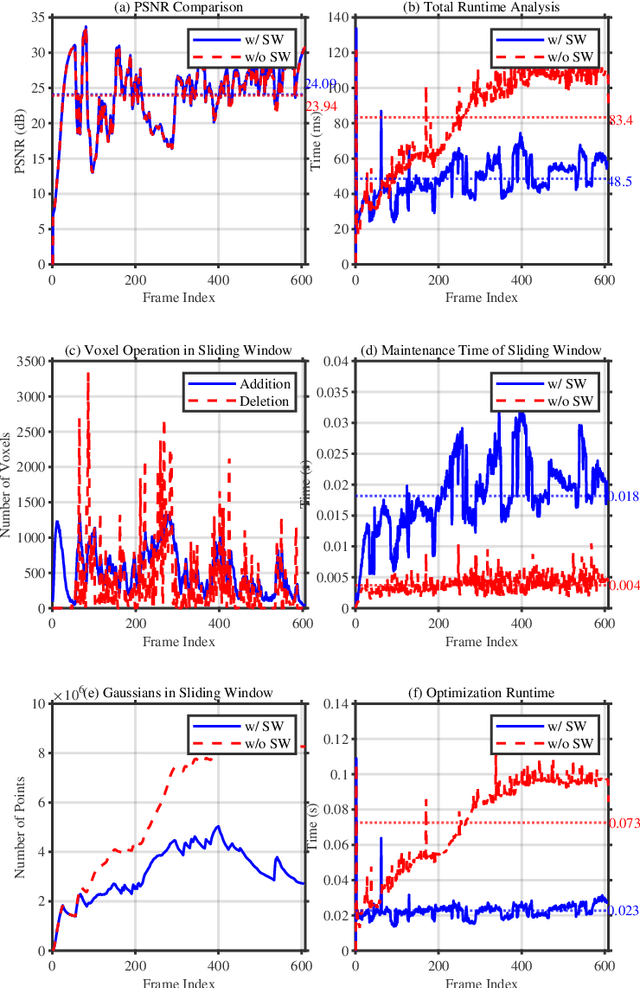


In recent years, 3D Gaussian splatting (3D-GS) has emerged as a novel scene representation approach. However, existing vision-only 3D-GS methods often rely on hand-crafted heuristics for point-cloud densification and face challenges in handling occlusions and high GPU memory and computation consumption. LiDAR-Inertial-Visual (LIV) sensor configuration has demonstrated superior performance in localization and dense mapping by leveraging complementary sensing characteristics: rich texture information from cameras, precise geometric measurements from LiDAR, and high-frequency motion data from IMU. Inspired by this, we propose a novel real-time Gaussian-based simultaneous localization and mapping (SLAM) system. Our map system comprises a global Gaussian map and a sliding window of Gaussians, along with an IESKF-based odometry. The global Gaussian map consists of hash-indexed voxels organized in a recursive octree, effectively covering sparse spatial volumes while adapting to different levels of detail and scales. The Gaussian map is initialized through multi-sensor fusion and optimized with photometric gradients. Our system incrementally maintains a sliding window of Gaussians, significantly reducing GPU computation and memory consumption by only optimizing the map within the sliding window. Moreover, we implement a tightly coupled multi-sensor fusion odometry with an iterative error state Kalman filter (IESKF), leveraging real-time updating and rendering of the Gaussian map. Our system represents the first real-time Gaussian-based SLAM framework deployable on resource-constrained embedded systems, demonstrated on the NVIDIA Jetson Orin NX platform. The framework achieves real-time performance while maintaining robust multi-sensor fusion capabilities. All implementation algorithms, hardware designs, and CAD models will be publicly available.
ParkingE2E: Camera-based End-to-end Parking Network, from Images to Planning
Aug 04, 2024


Autonomous parking is a crucial task in the intelligent driving field. Traditional parking algorithms are usually implemented using rule-based schemes. However, these methods are less effective in complex parking scenarios due to the intricate design of the algorithms. In contrast, neural-network-based methods tend to be more intuitive and versatile than the rule-based methods. By collecting a large number of expert parking trajectory data and emulating human strategy via learning-based methods, the parking task can be effectively addressed. In this paper, we employ imitation learning to perform end-to-end planning from RGB images to path planning by imitating human driving trajectories. The proposed end-to-end approach utilizes a target query encoder to fuse images and target features, and a transformer-based decoder to autoregressively predict future waypoints. We conducted extensive experiments in real-world scenarios, and the results demonstrate that the proposed method achieved an average parking success rate of 87.8% across four different real-world garages. Real-vehicle experiments further validate the feasibility and effectiveness of the method proposed in this paper.
Crowd-Sourced NeRF: Collecting Data from Production Vehicles for 3D Street View Reconstruction
Jun 24, 2024


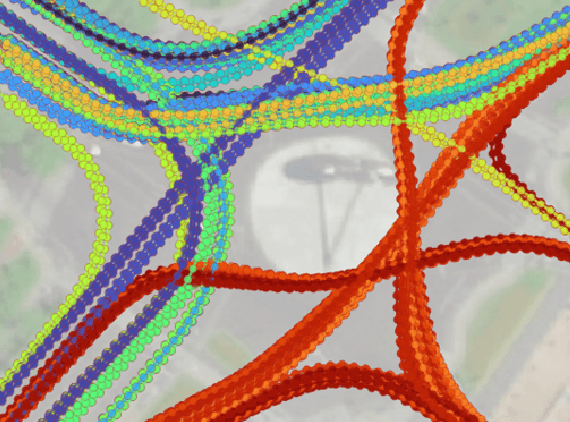
Recently, Neural Radiance Fields (NeRF) achieved impressive results in novel view synthesis. Block-NeRF showed the capability of leveraging NeRF to build large city-scale models. For large-scale modeling, a mass of image data is necessary. Collecting images from specially designed data-collection vehicles can not support large-scale applications. How to acquire massive high-quality data remains an opening problem. Noting that the automotive industry has a huge amount of image data, crowd-sourcing is a convenient way for large-scale data collection. In this paper, we present a crowd-sourced framework, which utilizes substantial data captured by production vehicles to reconstruct the scene with the NeRF model. This approach solves the key problem of large-scale reconstruction, that is where the data comes from and how to use them. Firstly, the crowd-sourced massive data is filtered to remove redundancy and keep a balanced distribution in terms of time and space. Then a structure-from-motion module is performed to refine camera poses. Finally, images, as well as poses, are used to train the NeRF model in a certain block. We highlight that we present a comprehensive framework that integrates multiple modules, including data selection, sparse 3D reconstruction, sequence appearance embedding, depth supervision of ground surface, and occlusion completion. The complete system is capable of effectively processing and reconstructing high-quality 3D scenes from crowd-sourced data. Extensive quantitative and qualitative experiments were conducted to validate the performance of our system. Moreover, we proposed an application, named first-view navigation, which leveraged the NeRF model to generate 3D street view and guide the driver with a synthesized video.